 +86 150 0573 0099
  alily@alilyenergy.com
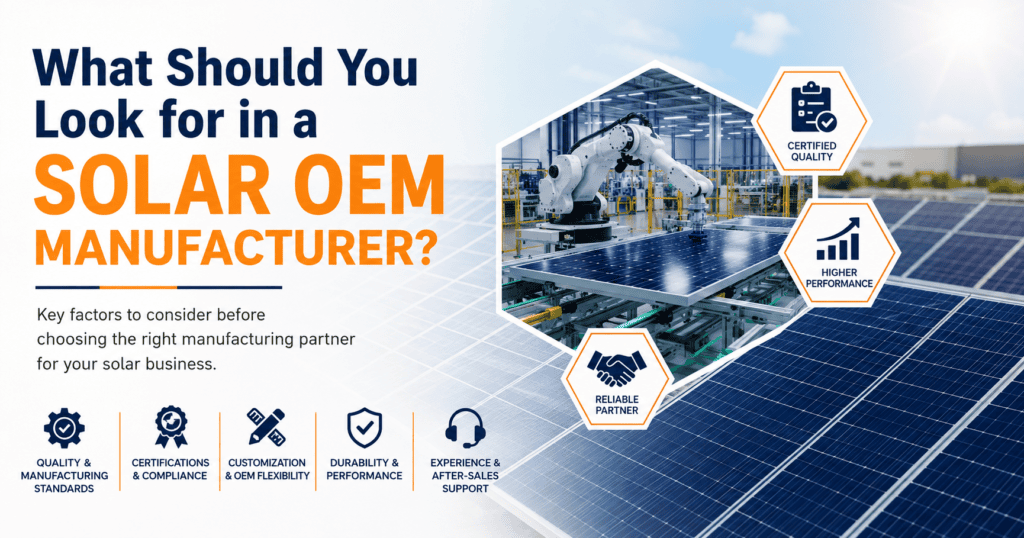
What Should You Look for in a Solar OEM Manufacturer?
Choosing a solar OEM manufacturer is not simply about finding a company that can produce solar panels at a competitive price. Solar modules are expected to perform for decades, often under intense heat, humidity, dust, wind, and other demanding environmental conditions. A manufacturing partner therefore needs to demonstrate much more than production capacity.
For businesses developing their own solar brand, distributors, EPC companies, project developers, and organizations entering the renewable energy market, the right OEM partner can influence product quality, project reliability, warranty performance, and long-term reputation.
Here are five important factors to consider when selecting a Solar OEM Manufacturer.
1. Check Manufacturing Quality and Production Capability
The first question should be straightforward: Can the manufacturer consistently produce the same quality at scale?
A professional solar OEM manufacturer should have clearly defined production processes, quality-control checkpoints, appropriate testing equipment, and traceability for critical components. The quality of a module depends on much more than the solar cell. Glass, encapsulant, backsheet or rear glass, junction box, frame, soldering, lamination, and electrical connections all influence long-term performance.
Ask about:
- Manufacturing capacity and production lines
- Cell and module technologies supported
- Incoming material inspection
- EL testing and visual inspection
- Flash testing and power classification
- Lamination controls
- Quality traceability
- Final inspection procedures
- Batch-level documentation
Electroluminescence testing, for example, can help identify hidden cell cracks and other defects that may not be visible during a normal visual inspection.
The objective is not to select the factory with the biggest capacity. It is to find a manufacturer whose processes are controlled well enough to deliver predictable quality from one production batch to another.
2. Verify Certifications and Product Compliance
Certifications should never be treated as decoration on a company website. Buyers should verify which product, model, factory, and testing body each certificate actually relates to.
For crystalline silicon PV modules, IEC 61215 is associated with design qualification and performance testing, while IEC 61730 addresses module safety. These standards are widely used as important benchmarks when evaluating module reliability and safety.
For the Indian market, buyers should also pay attention to applicable BIS requirements and MNRE’s Approved List of Models and Manufacturers (ALMM). MNRE states that models and manufacturers included in ALMM List-I are eligible for certain government and government-assisted projects, government schemes, open-access and net-metering projects in India.
Management-system certifications such as ISO 9001, ISO 14001, and ISO 45001 can also provide useful evidence of structured quality, environmental, and occupational-health processes. However, they should complement—not replace—product-specific testing and compliance.
For example, ALILY’s published module documentation identifies IEC 61215:2016 and IEC 61730:2016, along with ISO 9001:2015, ISO 14001:2015, and ISO 45001:2018 for the referenced bifacial module. ALILY also publicly states that it holds Inmetro, TÜV, and other certificates.
The important point is simple: verify the certificate against the exact module you intend to purchase.
3. Look Beyond Efficiency—Evaluate Long-Term Performance
A high efficiency number can attract attention, but it should not be the only deciding factor.
A good solar module needs to maintain useful power output over many years. Buyers should therefore examine degradation rates, temperature coefficients, mechanical-load ratings, PID resistance, operating conditions, warranty terms, and the materials used in the module construction.
For example, a module may have an impressive rated efficiency, but its real-world value depends on how it behaves under high temperatures, low-light conditions, humidity, and prolonged outdoor exposure.
Technology selection also matters. Depending on the application, manufacturers may offer technologies such as TOPCon, HJT, PERC, bifacial modules, or other configurations. The correct choice depends on the project rather than simply following the newest technology trend.
Ask the manufacturer for a detailed datasheet and understand:
- Module efficiency
- Power tolerance
- Temperature coefficient
- Degradation rate
- Product warranty
- Performance warranty
- Maximum system voltage
- Mechanical-load rating
- Operating-temperature range
- PID and environmental testing
A serious manufacturer should be able to explain these specifications in practical terms rather than simply providing a catalogue.
4. Assess Customization, Supply Chain and Delivery Reliability
OEM manufacturing becomes valuable when a business needs a product that fits its own market, brand, specifications, or project requirements.
Before signing an agreement, clarify how much customization is actually possible. This may include module dimensions, power ratings, cell configuration, branding, packaging, labels, connectors, electrical specifications, and documentation.
However, customization is only useful if the manufacturer can maintain supply consistency.
Ask questions such as:
Can the same BOM be maintained for repeat orders?
How are component substitutions approved?
What happens if a particular cell, glass, or encapsulant becomes unavailable?
What is the normal production lead time?
What is the minimum order quantity?
How are urgent replacement requirements handled?
Supply-chain transparency is particularly important for businesses building a long-term solar brand. A cheaper first order does not provide much value if subsequent batches have different specifications or inconsistent performance.
5. Evaluate Warranty, Technical Support and After-Sales Responsibility
This is one of the most overlooked areas when selecting an OEM partner.
Solar modules can remain in the field for 25 years or more. Problems may therefore appear long after the original purchase. A reliable solar OEM manufacturer should have a clear process for handling warranty claims, technical questions, replacement modules, documentation, and product investigations.
Do not evaluate warranty only by the number of years printed on the datasheet. Read the actual warranty conditions.
Understand:
- Who provides the warranty?
- Where must a claim be submitted?
- What evidence is required?
- Who pays transportation costs?
- How quickly are claims assessed?
- How are defective modules replaced?
- What happens if the original product is discontinued?
- Is technical support available after delivery?
It is also useful to examine the manufacturer’s previous project experience. A company that has supplied products for different climates, project sizes, and markets can provide valuable practical insight when selecting module configurations.
Final Thoughts
Choosing the right Solar OEM Manufacturer is ultimately a risk-management decision. Price matters, but it should come after quality, compliance, technology, manufacturing consistency, supply reliability, and after-sales support.
A strong evaluation should therefore look at the complete picture: factory capability, verified certifications, module performance, customization, supply-chain reliability, and long-term support.
For businesses building a solar brand, these five factors can make the difference between simply purchasing solar modules and developing a dependable product portfolio.
The best OEM relationship is not necessarily the one offering the lowest quotation. It is the one that can consistently deliver a technically sound product, provide transparent documentation, support the product after delivery, and maintain quality as your business grows.
Lily Li is a renewable energy professional and Founder & CEO of ALILY ENERGY GmbH with 20+ years of experience in the photovoltaic industry. Her experience includes PV manufacturing, solar products, energy storage, supply chains, and international solar projects, with previous professional experience at JinkoSolar and Znshine. She is also a CEIBS Global EMBA 2020 alumna and writes about solar technology, manufacturing, renewable energy, and the global PV market.